
Jimi Hendrix



Jimi Hendrix: The Man Who Turned Electricity Into Language
Some musicians master their instrument.
Jimi Hendrix mastered the air around it.
Hendrix didn’t just play guitar louder or faster. He changed what the guitar was allowed to say. He treated feedback like punctuation. Distortion like weather. Silence like threat. For musicians, Jimi isn’t a hero. He’s a rupture. Everything before him feels pre-industrial. Everything after him lives in his shadow.
What follows is an authentic career arc and 22 musician-level realities that working players, producers, and bandleaders still study when they want to understand how one person can permanently reset the vocabulary of sound.
Before Fame: Built on Survival, Not Myth
1. Hendrix learned on the road as a sideman
Backline discipline, timekeeping, and restraint came from playing behind others, not leading.
2. He played rhythm guitar obsessively
His lead work makes sense only because his rhythm feel was unshakable.
3. He absorbed R&B show discipline
Cue awareness. Tight endings. Serving the song before serving ego.
4. He listened harder than he spoke
Musicians who met him recall curiosity first, not bravado.
1966–1967: The Detonation
5. The Jimi Hendrix Experience was built for contrast
Minimal lineup. Maximum space. Every note mattered.
6. Hendrix played around the beat
Elastic timing created tension without rushing. This is nearly impossible to fake.
7. He used feedback intentionally
Positioning. Angle. Distance. Feedback became controllable tone, not accident.
8. His chord voicings were orchestral
Thumb-over bass notes freed harmony. Guitarists are still decoding this.
Monterey and Woodstock: Myth Meets Mechanics
9. Monterey was theatrical but precise
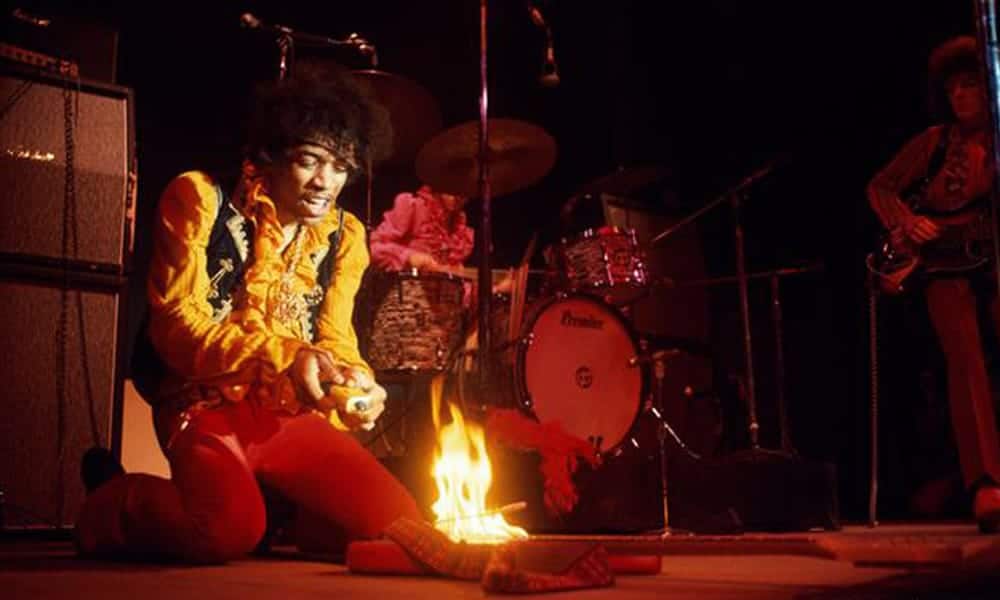
The guitar-burning moment followed a controlled performance. Drama came last.
10. Woodstock proved restraint could be louder than volume
His “Star-Spangled Banner” wasn’t chaos. It was commentary through sound.
11. He controlled massive crowds without crowd work
Dynamics did the talking. Silence commanded attention.
The Sound: Why It Still Feels Alive
12. Hendrix treated pedals as instruments, not effects
Fuzz. Wah. Uni-Vibe. Each was played, not toggled.
13. He stacked rhythm and lead simultaneously
Bass movement, chord stabs, melody—all at once.
14. Studio experimentation followed live instincts
He chased sounds he already heard onstage.
15. He trusted first takes emotionally
Perfection mattered less than ignition.
The Band Context
16. Drummers had to breathe with him
Rigid time collapsed. Feel carried everything.
17. Bass lines stayed grounded by design
Low-end stability gave guitar chaos somewhere to land.
18. Hendrix adjusted parts live constantly
No two nights matched exactly. The song lived.
Cost of Expansion
19. He carried the weight of invention alone
Everyone wanted the next miracle immediately.
20. The studio became a laboratory and a refuge
Freedom sometimes slowed decisions. Genius still needs structure.
21. He never stopped searching
New tunings. New bands. New directions. Restlessness fueled growth.
Legacy and the Unrepeatable
22. Hendrix proved tone is identity
Gear doesn’t make voice. Touch does.
Why Jimi Hendrix Still Matters to Musicians
Jimi Hendrix teaches a truth that unsettles every generation.
Technique is a door, not a destination.
Sound is a language, not a trick.
And courage matters more than correctness.
In an era where technology can imitate texture and AI can replicate style, Hendrix remains untouchable because his music wasn’t assembled. It was inhabited.
He didn’t adapt by fitting into the future.
He dragged the future into the present and dared everyone else to catch up.
Every guitarist who bends time, every band that lets noise speak, every artist who risks confusion in pursuit of truth is still responding to the shockwave Jimi Hendrix left behind—loud, human, and impossible to automate.
